
THE SYMBOLIC MEANINGS OF THE FLAGS OF ASANTES AND KUMERICA
Asantes National Colurs and Flags
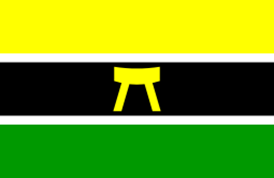
The Asantes National flag contains a gold horizontal strip [yellow colour] at the top (symbolizing the gold mineral soil, wealth and gold and riches of Asantes) and a green horizontal strip [green colour] at the bottom (representing the rich Asantes nation rainforest ecozone, enriched soil for farming and crop production); two thin-white horizontalstrips (is the purity and kindness of Asantes heart) and a black horizontal strip [black colour] at the middle in between the yellow and the green colours (which represents the black/dark colour skin/complexion of Asantes) surmounted by The Golden Stool [Sika Dwa] (which is the soul and the unity symbol of the Asantes) which has been the designated Asantes kingdom nation’s national symbol since 1600s into the present day 21st century.
This flag was designed and adopted in 1935, but the United States of Asantes (USA) was formed between 1500 and 1600s. The Golden Stool (Sika Dwa Kofi) descended from heavens in a cloud of white dust in the 1600s which officially marked the beginning of the Confederacy of the Asantes as one united nation (United States of Asante—USA).
The Asantes (Asante Region/Asante Kingdom) are the only people in Ghana with an official national flag. So, there are three main colours of the Asante Kingdom. The Asantes national colours are Yellow, Black and Green. The colour Red comes in when there is a war or when Asantehene or Asantehemaa is death. The Asante Kingdom flag was created and adopted by Asantehene Nana Prempeh II (Otumfuo Prempeh II) on 1st January, 1935.
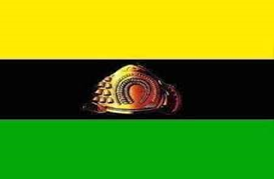
From the above two flags, the one at the left side is the official Asanteman National flag. But the one at the right is the official Manhyia Palace Flag which represents the seat OTUMFUO. So the right flag represents the power, the seat and the presence of OTUMFOɔ, the Asantehene (Asante King). But the left flag represents the entire Asanteman nation (Asante Kingdom) and the Asantes. There is a Dark Gold emblem (symbol) at the centre of the right flag in the black horizontal strip which is called Dɛnkyɛm kyɛ (the Crown of the Manhyia Palace). It is the symbol of authority of the Manhyia Palace. It literally symbolizes the protection of the King (OTUMFUO), and his readiness for war (battle) at any time. It is like modern-day helmet. The King wears it in times of war and, in times of grieve and bereavement.
Kumerica Flag
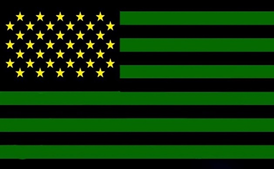
Kumasi is the only city in Ghana with a city/state flag called Kumerica flag. Kumerica flag was adapted from the flag of the United States of America. It was adapted in the middle of 2020 by the youth of Kumasi who nicknamed themselves as Kumericans and called the city [Kumasi] as Kumerica. Popular among the founders of the Kumerica movement are Blaq Foreigner, Armani Sossa, Bra Benk (Bernard Benk), David Germain Portfolio MC (as the PRO), Zoro-King (as the President), Akatafuo group (Akata Boys), City Boys, Asakaa Group, Kwaku DMC, Kawabanga, Reggie, O’Kenneth, Jay Bahd, Prince of Kumasi, Ypee, Oseikrom Sikanii, Yaw Tog, Obey, GAK, Phaize, Phrimpong, and some groups of young guys from Tafo, Krofrom, Ashtown, Santasi etc.
Some principal members include Archipalago, Hayford No-more-Walls, Kaakyire Y3dehye3 (KYD), Flowking Stone, Nana Sei (Strongman Burner), Papa Kumasi, kweku Flick, Bigscout Nana Prempeh, King Paluta, Amerado Burner, Sister Sandy, Reggie Rockstone, Zion Felix, Cabum, Lilwin, Naby, and all Kumericans in Kumerica. As to who first exactly or officially designed or created the Kumerica flag is still unknown. It popped up on the social media in the middle of 2020. Again, who initially or first called himself or coined and brought the term (name) [Kumerica] is still unknown. It is believed to have been coined by or brought by some of the groups of those young guys I mentioned above. Many Kumericans believe that the very group of people who coined and brought the name kumerica are Blaq Foreigner and Armani Sossa.
The Kumerica flag contains small alternate horizontal strips of black and green colours (7 black strips and 6 green strips or 6 green strips and 5 black strips or 6 black strips and 6 green strips), medium black rectangle shape with black background at the top left corner and 38 golden [yellow] stars in the black rectangle. The black colour symbolizes our dark/black skin colour (complexion); the green colour represents the beautiful rainforest ecozone of Kumasi [as the Garden City of West Africa], the enriched soil for farming and crop production in the Asante Kingdom. The yellow (gold colour) stands for the abundance of gold in Asante Kingdom, gold mineral soil and resources, wealth, gold and riches of Asantes as a shining beacon in a dark continent. The stars or the golden stars symbolize our multitude as countless as the stars in the skies. Not just the most populous in Ghana but also the most staring and shining and prosperous people.
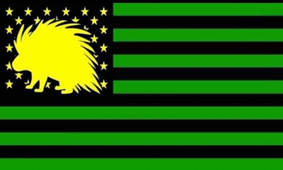
There is another version of the Kumerica flag which has a giant golden (yellow) porcupine (Kotoko) in the black rectangle surrounded by 25 golden (yellow) stars. The giant golden porcupine (Asante Kotoko) is a symbol of our strength, powers and might in a battlefield; it shows how united and strong and dangerous and powerful the Asantes are to resist, fight and conquer any enemy. The porcupine symbol means ‘Wukum a apem a, apem beba’ (if you kill thousand, thousand will come): literally if kill thousands of the Asantes, thousands of Asantes will come. The Porcupine (Kotoko) is displaying an inbuilt arsenal of sharp spikes for use when attacked by an enemy. The Asantes have the characteristics of the porcupine (Kotoko). The name (term) Kumerica alone is like a magic wand which adds value to your goods and services. This ingenious name (Kumerica) sounds so sweeter than a nectar, honey and milk combined.